



Studying people is harder than studying electrons.
People can indeed behave unintuitively.

The Quantum Dragon hasn’t tried studying people before, but after listening to Dr. Gita Gopinath, Founding Director of Global Economics Lab, quote Prof. Richard Feynman, he decided to give it a try. In the short week between last week’s newsletter and this one, I already heard him say “no thank you” as he walked back into his cave.
This week’s IQT News:
- Current and Future Product Development in Quantum Finance
- Looking Forward to Q+AI 3.0 & PQC
- Great Networking and a Dinner Cruise
- IQT Sunday Edition
- Q-Day is bad actors monetizing what they’re stealing today.
- Update on Financing of Quantum Chemicals & Quantum Life Science
- Paradigm Shift in Government and Institutional Funding for Quantum Finance
This week’s The Premium Quantum Dragon (Substack):
- But, again, who didn’t make DARPA’s cut?
- Infleqtion + Moonshot = Yaqumo
- Yonsei University’s Q-Bridge Platform
- QData Quantum Intelligence Terminal
- Qibo
- Keyfactor’s PQC Lab Test Drive
- Does IonQ own The Quantum Insider or not?
- Quip Network
This corpus is a diverse collection of text data from various sources, including websites, articles, and documents, covering topics such as technology (particularly quantum computing and machine learning), data protection and privacy policies, professional development and training, and company information. This collection includes contexts from many websites, financial reports, investor information, and corporate governance, which can be drawn upon to provide information and answer questions.
This week’s Friends of The Quantum Dragon (inline):
- The One and Only Neutral Atom Company by Dr. Ben Bloom, CEO of Atom Computing
- “Hardened open-source components can free cryptography specialists to focus on advancing quantum-resistant protection.” by Michael Wood, RapidFort CMO
- “Every quarter spent working through a migration roadmap is another quarter of exposure compounding silently.” by Simon Pamplin, CTO at Certes
In this edition:
- THIRD ITERATION OF QUANTUM+AI OFFERS 80 POWEHOUSE SPEAKERS AND GREAT NETWORKING; PQC TRACK INCLUDED
- The One and Only Neutral Atom Company
- Need a little Chinese propaganda in your life?
- Get to steppin’.
- “It’s time to build applications.”
- Look at the size of that thing.
- Did you plug it in?
- Not all blockchains are scared of quantum computers.
- Inside a Quantum Computer! with Andrea Morello
- It’s like trying to thread a needle while riding a jackhammer.
- I’ve never seen that before.
- “Hardened open-source components can free cryptography specialists to focus on advancing quantum-resistant protection.”
- Buy bonds!
- The Quantum Omelette Problem
- Lessons from Apple’s implementation of PQC in iMessage
- We still haven’t picked a modality!
- Q-Day is bad actors monetizing what they’re stealing today.
- The CQO needs a sunset clause.
- A Guinness-drinking Zuckerberg Meme
- Google’s Stir of Echoes
- “Every quarter spent working through a migration roadmap is another quarter of exposure compounding silently.”
- Spin qubits are finally getting some love.
- Quantum Noise Detector
THIRD ITERATION OF QUANTUM+AI OFFERS 80 POWERHOUSE SPEAKERS AND GREAT NETWORKING; PQC TRACK INCLUDED
Q+AI October 25-27 in New York City is a week from starting. The speaker lineup authored by Bob Sutor and Brian Siegelwax offers over 80 speakers including several exciting “fireside” chats. Cantor Fitzgerald is chairing the always interesting “chief executive” session; the event also includes a unique “show me the money” session. Q+AI also provides one of the few PQC tracks on 26 October. Registrants to Quantum+AI are entitled entry to the PQC seminar. A networking hall includes a dozen sponsors and several hours meeting fellow attendees. Complete registration information: www.iqtevent.com.
The One and Only Neutral Atom Company
Following the announcement that Atom Computing was the only neutral atom quantum computer builder selected by the Defense Advanced Research Projects Agency (DARPA) to advance to the final stage (Stage C) of its Quantum Benchmarking Initiative (QBI), Dr. Ben Bloom, CEO of Atom Computing, provided this unique quote:
“To be the only neutral atom company selected by DARPA to advance to Stage C of the Quantum Benchmarking Initiative (QBI) is another exciting milestone for Atom Computing. We believe our highly scalable, neutral atom architecture and recent demonstrations of end-to-end quantum error correction will show that utility-scale, fault-tolerant quantum computing is much closer than many expect.”
Need a little Chinese propaganda in your life?
You may or may not be following US government investments in quantum, but if you are, “Pentagon unveils US$350 million quantum computing push as China rivalry grows” offers China’s perspective. The South China Morning Post operates out of Hong Kong, but is owned by China’s Alibaba, and it shows.
Get to steppin’.
QuEra’s Chief Commercial Officer, Yuval Boger, doesn’t actually say that. But what he does say in this 1:02 video clip is the criteria for turning away collaborative projects. You usually find companies listing what they will do, not what they won’t do, so kudos on flipping the script. This link may require a LinkedIn account.
“It’s time to build applications.”
DecaQ.ai imaginatively illustrates how its technology doesn’t need a roadmap and is ready right now for developing applications. This was one of my suggestions, actually; it works to the extent that I can test it, making easy work out of my entire library, so DecaQuasar needs a real-world test. This link may require a LinkedIn account.
Look at the size of that thing.
This is a closeup look at IBM’s new modular cryogenics, and even our tour guide, Allie Lindler, calls the one module “massive.” At some point, you have to do the math of how infeasibly large a 1,000,000-physical-qubit quantum computer would be using IBM’s current architecture. This link may require a LinkedIn account.
Did you plug it in?
Speaking of IBM’s massive quantum computers, here’s a video showing the assembly of Yonsei University’s IBM System One. Notice how they show the glass enclosure off by itself, as if that’s the whole thing. Later in the video you see some more equipment, and you have to remind yourself that all of that is for only 127 physical qubits.
“Every coin launched here gets a mint address derived from IBM quantum measurements.”
Not all blockchains are scared of quantum computers.
The imaginatively named QUBIT doesn’t mention post-quantum cryptography at all. Instead, it deviates from other blockchains and uses IBM quantum computers to frivolously mint coins. Ironically, since they’re measuring quantum circuits, even the random numbers aren’t cryptographically secure.
Inside a Quantum Computer! with Andrea Morello
What will I be watching on my 14-hour flight across the planet to Q+AI/PQC+IQT? Besides the insides of my eyelids, this 1:34:09 video is downloaded and ready to watch. I clicked around a little bit, and I’m really fighting the urge to watch it now, because what else am I going to watch for 14 hours?
https://a.co/d/0i1fndcr
It’s like trying to thread a needle while riding a jackhammer.
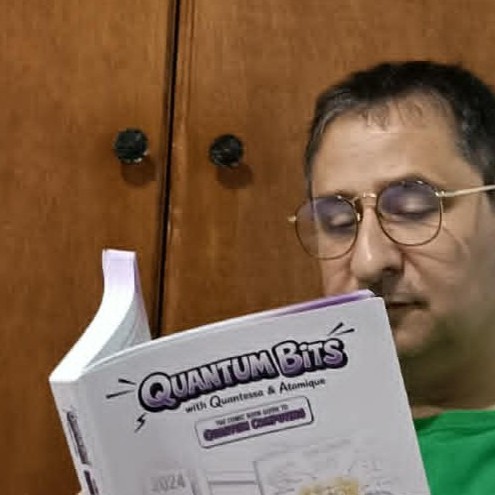
The Quantum Dragon doesn’t have a Hall of Fame, but if he did, Yuval Boger’s illustration of “cryogenic cooling” in “Quantum Bits” would be the inaugural entry. In a million years, I gotta say I never would’ve come up with that. Maybe I could stumble upon an “eye of the needle” analogy, but jackhammers don’t enter many of my thought processes.
https://a.co/d/07IJjYvD
I’ve never seen that before.
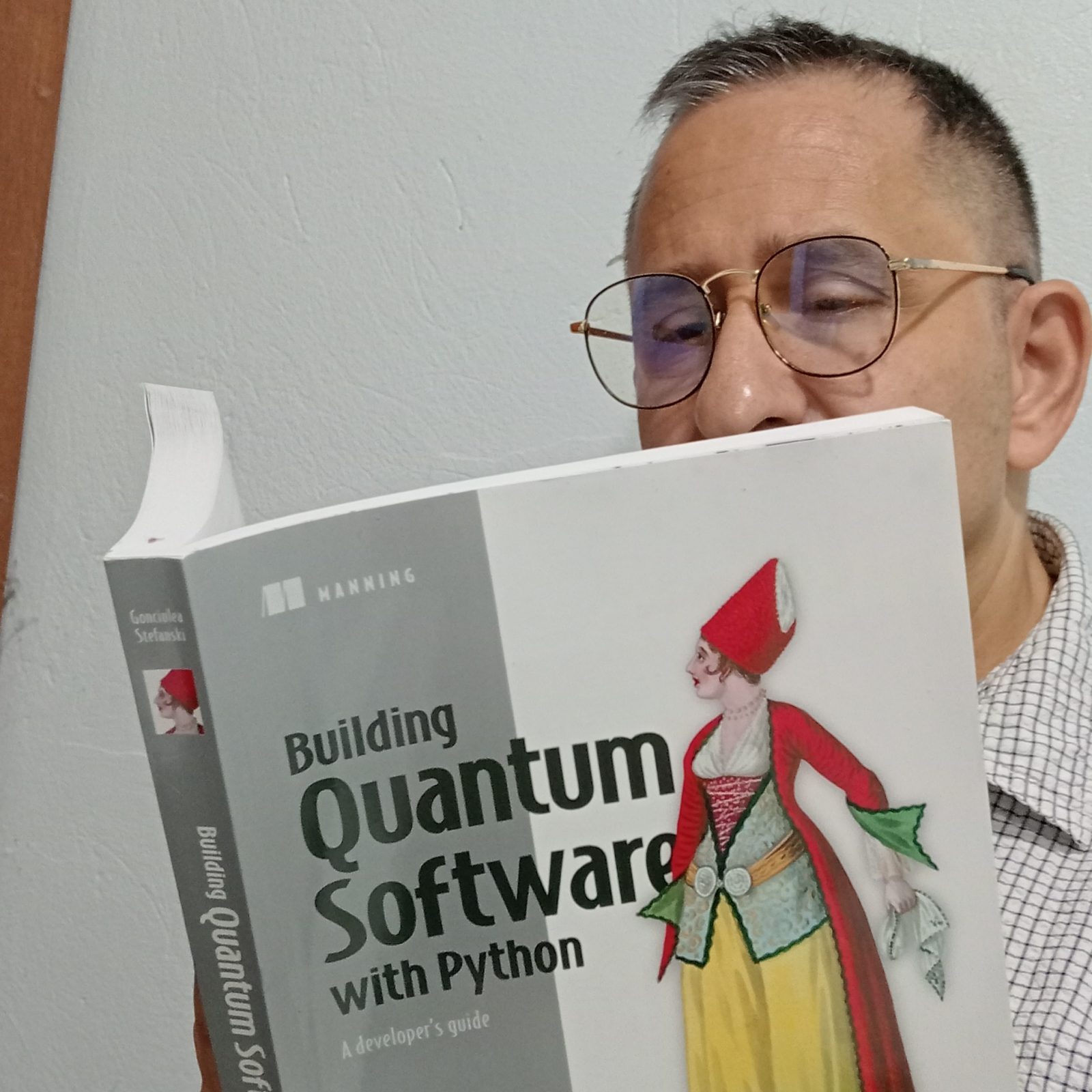
My first impression of “Building Quantum Software with Python,” by Dr. Constantin Gonciulea and Charlee Stefanski, is that there are illustrations that I haven’t seen in any other quantum book, report, article, blog post, or social media post. Histograms are always bars, not rose charts, so that ought to keep the book interesting as we proceed along.
“Hardened open-source components can free cryptography specialists to focus on advancing quantum-resistant protection.”
Following the announcement that RapidFort has entered into a cooperative research and development agreement with SpaceWERX to improve cyber readiness and reduce ATO timescales for the U.S. Space Force, Michael Wood, RapidFort CMO, provided this exclusive comment:
“Post-quantum security is only as strong as the software delivering it. Our work with PQC companies demonstrates how hardened open-source components can free cryptography specialists to focus on advancing quantum-resistant protection instead of maintaining dozens of third-party images. Crypto agility also requires software agility and the ability to deploy new algorithms and security updates quickly, on a foundation that is continuously maintained. That same principle guides our collaboration with SpaceWERX as we help prepare critical space systems for emerging quantum threats.”
Buy bonds!
World War II is long over, fortunately, but according to 1440, the original manuscript on special relativity was lost following its submission for publication, and Prof. Einstein reauthored it to support a bond rally. It would be interesting to know how well it did, but that part’s missing. There’s an image of it, though.
The Quantum Omelette Problem
I could share this for the title alone, but instead, I’m going to go with the reinterpretation of Salvador Dalí’s The Persistence of Memory (1931). That’s worth a look. Along the way, you can read about how the heck this analogy fits quantum thermodynamics. I’m wondering, however, why I don’t recall eating Indian food with eggs?
Lessons from Apple’s implementation of PQC in iMessage
I’m used to reading, and perhaps even writing a little, about the need to migrate to post-quantum cryptography. Dr. Rajiv Shah provides the first “lessons learned” I’ve encountered. I guess the next stage in the evolution would be best practices? Fortunately, PQC+IQT is right around the corner, so I’ll get all caught up there.
We still haven’t picked a modality!
I missed this angle in “But, again, who didn’t make DARPA’s cut?,” but Dr. Anastasia Marchenkova caught it. Through Stage A and Stage B of DARPA’s Quantum Benchmarking Initiative (QBI), we somehow still haven’t whittled down the pool of prospective modalities. By modality, literally everyone is still in contention. Unbelievable.

Image generated by an AI model provided by Microsoft Copilot.
Q-Day is bad actors monetizing what they’re stealing today.
Given time, the term “Q-Day” might surpass the word “run” as having more definitions than any other term. According to Oxford English Dictionary’s latest edition, the word “run” has 645 distinct meanings. Although I haven’t counted every definition of “Q-Day,” it sure feels like the industry is trying to break the record.
The CQO needs a sunset clause.
Wouldn’t it be great (#irony) to accept a role with an expiration date? Well, I guess all contract jobs have that, but Mark McGuire writes that the very position of Chief Quantum Officers, which is presumably non-contract, should not be long-term. That’s not referring to anyone’s job, mind you, but the role itself.
A Guinness-drinking Zuckerberg Meme
Kudos to Quantum Machines for turning the viral video clip of Meta’s Mark Zuckerberg apparently trying Guinness for the first time into a relevant quantum computing meme. In his defense, if you’ve never tried Guinness before, and you’re expecting it to taste like a typical beer, you’re legitimately in for a shock. This link may require a LinkedIn account.
Google’s Stir of Echoes
I’ve never heard of the 1999 film “Stir of Echoes,” let alone seen it, so that makes Prof. Amit Hagar’s use of it as an analogy double unique for me. He uses it as a lead-in to explain Google’s “Quantum Echoes” experiment. I’m awarding some admittedly worthless bonus points because the movie stars Kevin Bacon.
“Every quarter spent working through a migration roadmap is another quarter of exposure compounding silently.”
Following the statement by Alessandro Curioni, IBM’s Vice President for Europe and Africa, that fewer than 10% of organizations worldwide have taken steps to protect themselves against future cryptographically relevant quantum computers, Simon Pamplin, CTO at Certes, said:
“Fewer than one in ten organisations have taken meaningful steps toward quantum-safe security, and the reason is rarely ignorance of the threat. Quantum migration feels too complex and too slow to begin, and that perception is where the real risk lies.
The conventional approach, cryptographic inventory, dependency mapping, infrastructure modernisation across legacy systems, describes a process measured in years. But that framing presents a false choice. Harvest now, decrypt later does not wait for infrastructure programmes to complete. Adversaries are accumulating encrypted data today, and every quarter spent working through a migration roadmap is another quarter of exposure compounding silently.
The more immediate path to quantum resilience runs through the data itself. Applying data-centric, quantum-safe protection directly to sensitive information does not require infrastructure to be overhauled first. It can be deployed as a parallel activity, reducing the window of exposure from years to weeks while longer-term modernisation continues at a manageable pace.
Quantum readiness does not have to mean waiting until every system has been inventoried and upgraded. It means ensuring the data moving through those systems is protected now, regardless of what it encounters along the way.”
Simon Pamplin, CTO of Certes, will be speaking at PQC+IQT, which is coming to New York City October 25-26.
Spin qubits are finally getting some love.
That’s QuantumJane’s point, in a nutshell, but she uses a 6:03 video to interview folks at Quantum Motion and to otherwise make her point. Perhaps even more interesting, is that when I went off on a tangent to link to The Beatles’ “All You Need is Love,” it sure looks like there’s a young Mick Jagger in the audience singing along?

Image generated by an AI model provided by Microsoft Copilot.
Quantum Noise Detector
Alan Ho and Prof. Michael Biercuk inspired the Resuscitated Quantum Bullshit Detector, but the original(?) has resurfaced on Bluesky. It’s back to reposting a simple “bullshit” or “not bullshit,” so The Quantum Dragon will continue to monitor for challenges, controversies, and debates under this new name from Dr. Bob Sutor.
- Prof. Amit Hagar takes issue with how Atom Computing and IonQ use the term “breakeven.”
- Prof. Amit Hagar also takes a swing at Oratomic’s new valuation.