January 23, 2026
The Alpha Cat of the Clowder
The alpha cat is the influencer of the clowder.
I missed this back when AWS announced its cat qubits. There’s a blog post about the architecture, and I missed the name Lescanne in the citations. If you open the link to the paper, you’ll also find the name Peronnin. Why is that interesting? AWS is citing the founders of Alice & Bob, the only other cat qubit provider.
This week’s premium content:
- The NSF paid for WHAT?!?!?
- DarkStarStrix QSolvers
- I wanna play with logical qubits.
- My Favorite Debate in Quantum Thus Far
In this edition:
- qplaylearn needs to be resurrected.
- There can be only one.
- National Quantum Initiative Reauthorization Act of 2026 – Section Summary
- Welcome… to SPAComania!
- Here’s some news out of China… Wait, what?!?!?
- What does “early FTQC” mean?
- Diamonds are a quantum computer’s best friend?
- Henry Ford might be proud.
- Barbie and The Sims
- Quantum Noise Detector
qplaylearn needs to be resurrected.
How did this not take off? Photonic Trail looks like an interesting game, adding a story to Quantum Flytrap’s Virtual Lab. Q|Cards is still available on Google Play. Sort of. There is no one else online to play against. And Quantum Pills is a heck of a name for short videos. Unfortunately, it all seems long abandoned.
There can be only one.
You may have read that there is a novel “‘work around’ of the no-cloning theorem.” Not that I’ve followed this too closely, but this article by Bill Bell of Quantum Campus is the first I’ve seen that points out that you can only decrypt one of the copies. So, yes, this has applications, but in the end, there can be only one.

National Quantum Initiative Reauthorization Act of 2026 – Section Summary
Thanks to Paul Stimers, Partner at Holland & Knight LLP, for sharing this section summary of the National Quantum Initiative Reauthorization Act of 2026.
Welcome… to SPAComania!
If you’re a paid subscriber of Dr. Bob Sutor’s Sutor Group, you’ve already seen this. But if you’re not, you can at least enjoy the title. Better yet, you can subscribe.
Here’s some news out of China… Wait, what?!?!?
I never share news out of China unless I’ve hunted down a hyped-up quantum computer, in which case I’m probably criticizing it as being hot garbage. But this is the first article I’ve seen that’s actually well grounded. Take, for example, the expression “significant domestic breakthrough.” That’s actually reasonable.
What does “early FTQC” mean?
Once upon a time, I nominated Prof. John Preskill to develop the official glossary of all things quantum. In the continued absence of such a document, here are Dr. James “The Dungeon Master of Quantum Computing” Wootton, Craig Gidney, and a few others trying to hash this one out.
Diamonds are a quantum computer’s best friend?
I’m primarily sharing this Forbes article about Quantum Brilliance because of the title, but I’m awarding admittedly worthless bonus points for the phrase “traditional quantum computing.” Interestingly, Quantum Art is the only other named quantum computing company in the article.
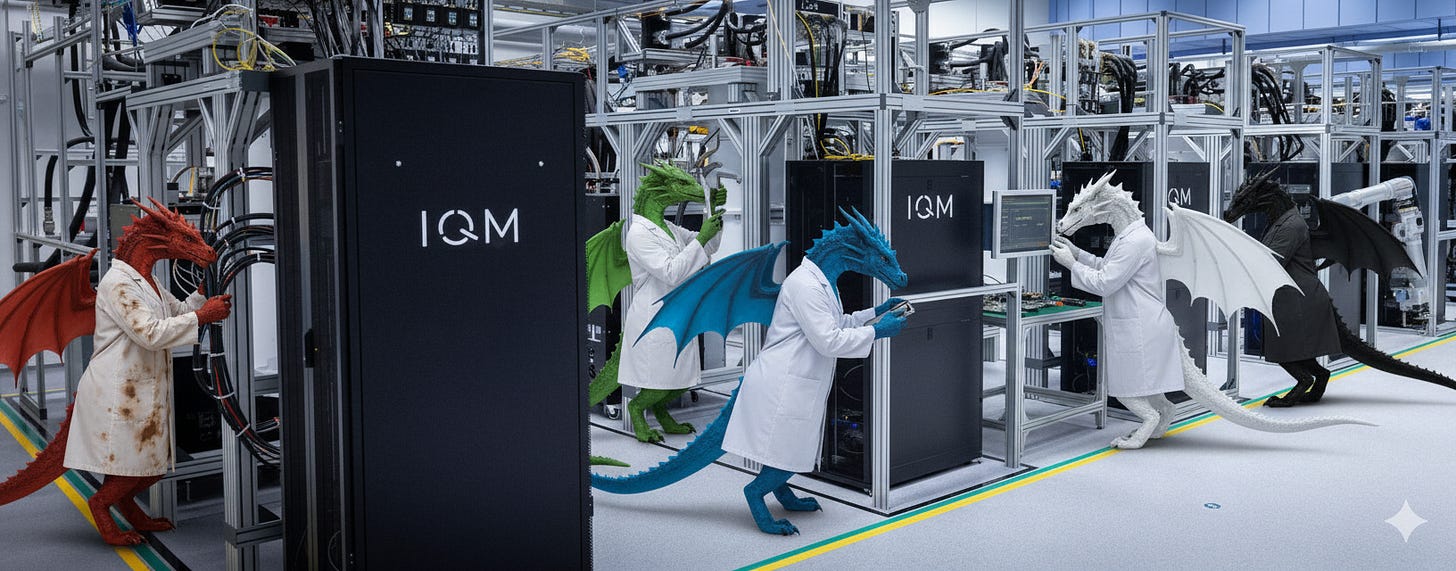
Henry Ford might be proud.
IQM is investing over €40M to hire quantum dragons and expand its production facility. Disclaimer: they’re only acknowledging half of that statement.
Barbie and The Sims
Congratulations to Dr. Aggie Branczyk and her Quantum Salon for invoking two major franchises, neither of which I’ve used before, in one article. She then wrapped them up in a cooking analogy, which I’ve only touched upon unless you count Quantum Ice Cream.

Quantum Noise Detector
Alan Ho and Prof. Michael Biercuk inspired the Resuscitated Quantum Bullshit Detector, but the original(?) has resurfaced on Bluesky. It’s back to reposting a simple “bullshit” or “not bullshit,” so The Quantum Dragon will continue to monitor for challenges, controversies, and debates under this new name from Dr. Bob Sutor.
- Four months ago, IonQ Chairman & CEO Niccolo De Masi claimed that IonQ will “wipe the floor” with supercomputers in 2027. This week, IonQ President of Quantum Computing Chris Ballance said that he doesn’t think anyone even has the winning modality yet, and that innovation will still be incredibly important over the next 3, 4, 5 years.
Filed under: Quantum Computing • Quantum Hardware • Industry Analysis
January 16, 2026
null
Inspired by a thread with Dr. Aggie Branczyk about quantum stock valuations, I present to you a newsletter about nothing. I wanted to keep it blank, but I didn’t think IQT would...
January 9, 2026
The 2026 International Year of Post-Quantum
Thanks to a post by Jack Krupansky, I had an epiphany that the 2025 International Year of Quantum Science and Technology (IYQ) should’ve been followed up by The 2026 International...
January 6, 2026
IQT The Quantum Dragon Podcast Episode 78 – “Open a secure channel.”
Quantum Corridor and Toshiba announced the demonstration of the first cross-state Quantum Key Distribution (QKD) over a live commercial metro fiber network, and I had questions...
January 2, 2026
2026 Year in Review
The reviews of 2025 came as early as November last year, so I decided I would beat them all to the punch in 2026. And let me tell you, what a year it was! The IQT conferences were...
December 29, 2025
May Your Qubits Be Merry and Bright
Although this week’s title may initially seem festively silly, let’s not forget that qubits can indeed get excited, and that atoms and ions can indeed fluoresce. And, of course,...
December 19, 2025
Barron’s Guide to Butchering IBM Quantum
Barron’s “How Quantum Computing Could Put IBM Back on Top Again” is paywalled, but you may be able to catch this gem near the top: “IBM has deployed 85 quantum systems to over 300...
December 12, 2025
The least qualified dragon in quantum.
The Quantum Dragon saw “Product Commercialization / Licensing Lead” and decided to apply to PQSecure per the instructions. Unfortunately, aside from actually being quantum, he’s...
December 5, 2025
What does mobile QKD look like?
Germany has apparently achieved hybrid quantum key distribution across mobile and fiber channels. I made the mistake of wondering aloud if a future-generation unit might have...





Subscribe to Our Email Newsletter
Stay up-to-date on all the latest news from the Quantum Technology industry and receive information and offers from third party vendors.