



Microsoft is making significant advances in quantum computing across multiple qubit modalities
Many paths to useful quantum computing
Each type of qubit comes with its own benefits and challenges that scientists must balance as they design and engineer quantum computers. As a result, there are more paths to building a practical quantum computer than there are types of qubits.
Regardless of which qubit modality propels the industry furthest, the end goal remains the same: building a quantum computer that can solve real-world problems to benefit all of humanity. Microsoft Quantum has made significant advances across multiple qubit modalities through breakthroughs in physics, engineering, and error correction that are shortening the path to useful quantum computing.
Topological quantum computing
Last year, Microsoft Quantum announced Majorana 1—the world’s first quantum processor built with topological qubits. Due to their small size, hardware-enabled error protection, and digital control, topological qubits are uniquely suited to scale. Majorana 1 was realized after the team made a breakthrough in physics that led to the creation of topological superconductivity. Designed to scale to a million qubits on a single chip that can fit in the palm of your hand, Majorana 1 marked the first tangible milestone on the path to scalable quantum computing.
This corpus is a diverse collection of text data from various sources, including websites, articles, and documents, covering topics such as technology (particularly quantum computing and machine learning), data protection and privacy policies, professional development and training, and company information. This collection includes contexts from many websites, financial reports, investor information, and corporate governance, which can be drawn upon to provide information and answer questions.
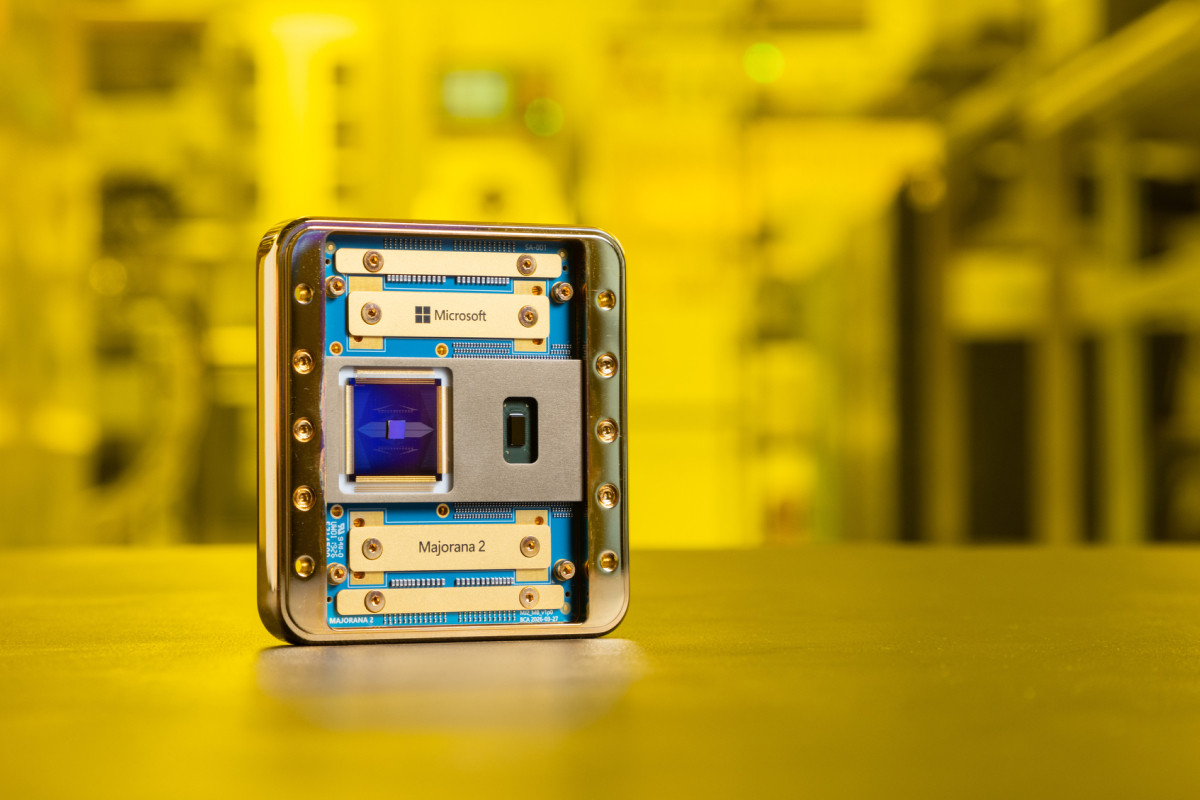
Microsoft Quantum recently announced Majorana 2, the next generation of topological quantum processors. Majorana 2 was built with a new material stack (Figure 1), designed with AI. By replacing the aluminum in Majorana 1 with lead, the team was able to create topological qubits that have operations on the microsecond scale and lifetimes averaging 20 seconds.

Figure 1. The new hybrid material stack of Majorana 2 consists of lead above a composite quantum well.
Changes in the material stack created a more stable topological phase, extending qubit lifetimes. The topological gap, which protects topological qubits from environmental noise and errors, more than doubled in size from Majorana 1 to Majorana 2. This engineering breakthrough produced topological qubits 1,000x more stable than those in Majorana 1. The rapid progress over the course of a year cut the team’s timeline in half for delivering a scalable quantum computer, which is now anticipated by 2029.
Neutral-atom quantum computing
In 2024, Microsoft and Atom Computing announced the creation and entanglement of 24 logical qubits, made possible by applying the Microsoft Quantum platform to Atom Computing’s neutral-atom qubits. The teams also demonstrated the ability to detect and correct errors, and perform computation, on 28 logical qubits.
The following year, QuNorth announced Denmark’s investment in a quantum computer co-designed by Microsoft and Atom Computing. This machine, named Magne, will be the world’s first commercial quantum computer with 50 logical qubits

Figure 2. An artistic rendering of Magne, which is expected to be ready for its first tasks by early 2027.
The Microsoft Quantum platform
The Microsoft Quantum platform is a highly versatile full-technology stack that can improve the reliability of multiple types of qubits. It includes everything needed for building quantum applications such as hybrid quantum-classical development tools, AI agents, and cloud connectivity.
The platform also includes the Microsoft Quantum Development Kit (QDK), which offers AI-powered tools that are fully integrated with VS Code and GitHub Copilot. The QDK provides useful features for developers to build, run, and debug quantum programs for today’s quantum computers and the more powerful ones soon to come. It offers free, open-source access to Microsoft’s tools for quantum error correction and an end-to-end workflow for solving scientific problems with quantum.
By applying the Microsoft Quantum platform to multiple qubit modalities—and continuing to improve the performance of topological qubits—Microsoft is paving the way to practical quantum computing.
SPONSORED ARTICLE; author Deborah A. Hutchinson