
It’s not easy for The Quantum Dragon to find work. After all, good luck telling a firebreather what to do. Fortunately, however, he recently found one way to commercialize his quantum talents. It’s not in his personality to sit around counting time like decades-old atomic clock technologies, but, apparently, the next real-world application of “quantum” is in quantum-sensing-based semiconductor inspection, the diagnostic step fabs turn to when they need to find out why chips are failing before a process is ready for volume production.
This is neither a proof-of-concept in a laboratory nor a field test, ladies and gentlemen. QuantumDiamonds is earning revenue with this today; in fact, 9 of the 10 largest chipmakers in the world are reportedly already engaged with the technology.
The Problem
Failure analysis is important because as we squash more and more components onto semiconductor chips and then pack these chips into more and more layers, it’s getting harder to figure out if something works before putting it into production. If we can identify a problem, we can stop the job and identify the step that failed. And of course, the earlier we can identify a problem, the better.
Furthermore, yield is really hard to get right. Not only is it difficult to produce chips flawlessly, but alternative processes to quantum sensing are slow and challenging to do non-destructively. It’s also expensive; a 1% improvement for a company like TSMC is worth billions of dollars.

Credit: QuantumDiamonds GmbH
The Solution
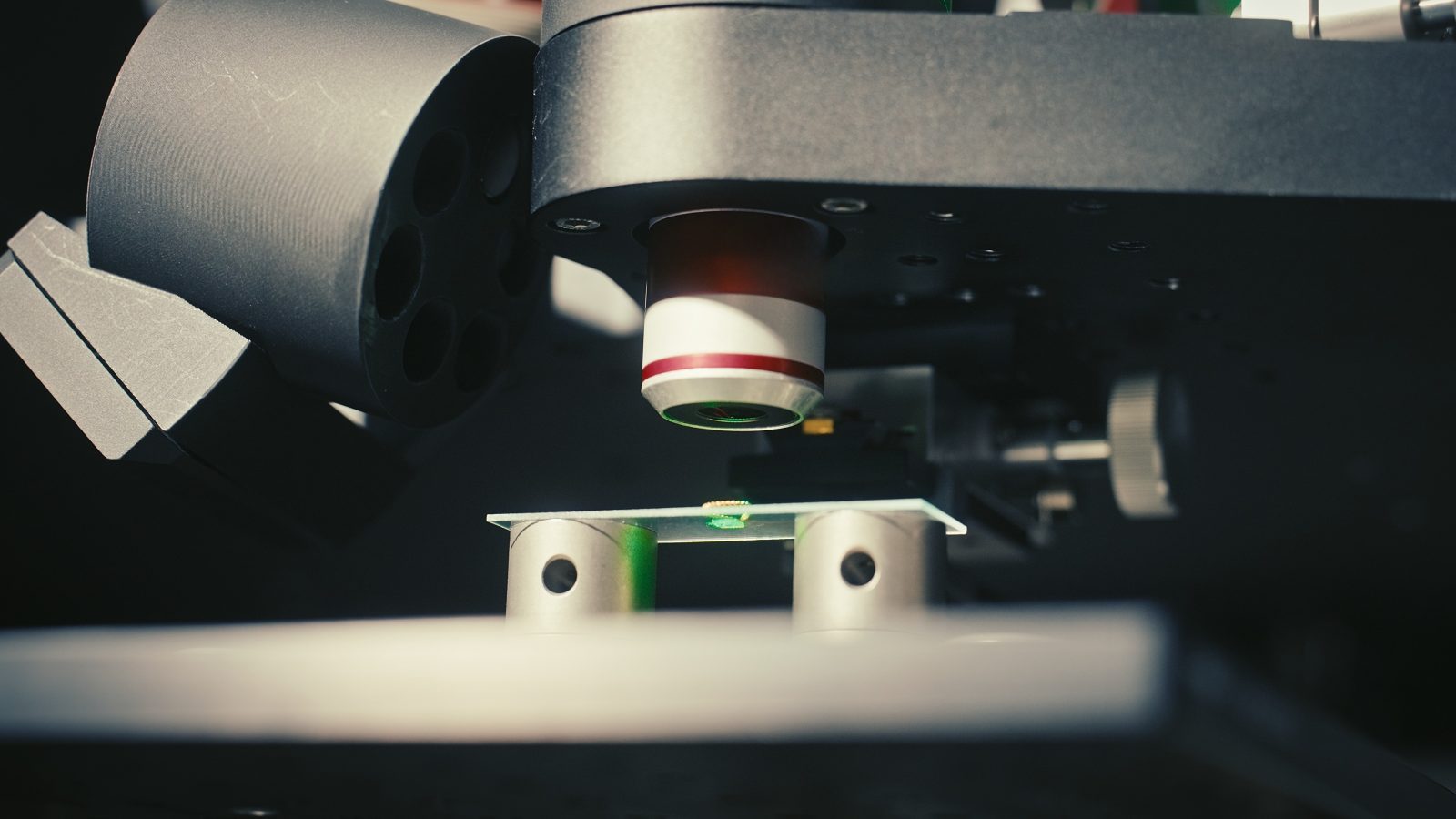
Widefield magnetometry using nitrogen-vacancy centers in a few square millimeters of engineered diamond can read the magnetic fields that are produced by current as it flows through a chip. A laser can read the shifts this causes in quantum states, and then the path of the current can be reconstructed in 3 dimensions, many layers deep depending on their consistency and thickness, allowing fabs to find electrical faults that structural tools such as X-rays, e-beams, and thermal simply can’t. Finding these faults, however, only becomes more important as we add layers in a 3rd dimension.
Perhaps more importantly, these sensors work non-destructively. What’s an unfamiliar term to a dragon is an important consideration for a fab.
The Market
The potential customer count is hard to figure out. TSMC makes 80% of advanced chips, so the value can be measured in at least tens of billions of dollars. This technology applies to power electronics, memories, some drone and robotics chips, and other bleeding-edge technologies. It does not apply to all chips, however, as some chips are relatively large and simple, and their yields are well established. This tech applies to advanced chips on the low-nm scale.
An open question is whether or not quantum computing is a potential use case. It’s certainly farther out on the horizon, but we’re eventually going to have, at scale, semiconductor chips in cryogenic environments. For that matter, we’re going to have superconducting chips. The emphasis on room-temperature semiconductor chips is due to their manufacture at scale today, but QuantumDiamonds now has this question to discuss around the proverbial water cooler.
The Source
QuantumDiamonds is a spinout of the Technical University of Munich. Although not the focus of this article, I inquired as to why Germany seems to be the global hotspot of NV technologies, both for quantum sensing and for quantum computing. The technology was born in Germany, so that certainly might be a contributing factor, but why hasn’t it proliferated? I leave that for you to discuss around your own water cooler.
It may be of interest to American readers that the technology is already on US soil. QuantumDiamonds’ first US installation is a QD m.1 system at Eurofins EAG Laboratories in Sunnyvale, California, an independent failure analysis house that runs work for chipmakers across the industry.
Conclusion
One US chip designer reportedly reduced 6 weeks of debugging to under a minute. The Quantum Dragon can’t bill by the minute, so he’s decided to leave this work to the fine folks at QuantumDiamonds and their quantum magnetometers.
With the exception of atomic clocks, which are so ubiquitous we often neglect to talk about them when we talk about quantum technologies, we’re forced to use the future tense a lot. Quantum computers are the future. Quantum networks are the future. And while quantum sensors for GPS-denied/spoofed navigation, in particular, have kicked open the door and are trying to get out there, we have another quantum sensor that is deployed in the real world and generating revenue today.
