

This is an unorthodox newsletter, even by my standards. I’ve been at Q+AI 2026 (3.0) and PQC+IQT all week, including trans-global travel, which means that I’ve been flying and listening to speakers far more than I’ve been surfing the Internet. So, here are the notes The Quantum Dragon took as he followed me around the event hall.
This week’s IQT News:
- New York, New York
- IQT Sunday Edition
- IQT The Quantum Dragon Podcast Episode 91 – Let’s Drink Coffee
- Pioneers in Research & Industry Driving Quantum Chemistry & Life Science Long-Term Commercialization
- Pioneers in Research and Business Driving Quantum Finance
This week’s The Premium Quantum Dragon (Substack):

This corpus is a diverse collection of text data from various sources, including websites, articles, and documents, covering topics such as technology (particularly quantum computing and machine learning), data protection and privacy policies, professional development and training, and company information. This collection includes contexts from many websites, financial reports, investor information, and corporate governance, which can be drawn upon to provide information and answer questions.
This week’s Friends of The Quantum Dragon (inline):
- A Molecular Qubit that can be Accessed and Controlled Using Light by Ilai Schwartz, CTO and Co-Founder at NVision
- A Way to Demonstrate and Calibrate Breaking RSA-2048 on Early Quantum Processors by Dr. Dahmun Goudarzi, Senior Cryptanalyst at Alice & Bob
- “2027 is the last year organizations can afford to start planning if they expect to meet the deadlines.” by Chris Hickman, Chief Security Officer at Keyfactor
- You can’t hire quietly at scale. by Karolis Didziulis, Product Director at Coresignal
In this edition:
- Networking? You don’t say…
- The Pros and Cons of Fluxonium Qubits
- What would you expect from folks who work at Wells Fargo?
- Put Your Brand in Front of the Industry’s Decision-Makers
- A Molecular Qubit that can be Accessed and Controlled Using Light
- A Way to Demonstrate and Calibrate Breaking RSA-2048 on Early Quantum Processors
- “2027 is the last year organizations can afford to start planning if they expect to meet the deadlines.”
- You can’t hire quietly at scale.
Networking? You don’t say…
The theme of this newsletter, queued up well in advance of the event, anticipated having time to write and curate on the fly. This was my first IQT event, though, and I thoroughly underestimated what everyone meant by “networking.” Rather than rush to assemble my jetlagged mental notes, expect a lengthy newsletter next week.


https://a.co/d/0i1fndcr
The Pros and Cons of Fluxonium Qubits
I admit to knowing little about fluxonium qubits, and Yuval Boger’s “Quantum Bits” explains why: they’re not “out there” yet. He both writes and illustrates the advantages they offer over common transmon qubits… but only individually. They apparently don’t yet play nicely with each other, which would make connectivity comparable to China’s systems.

https://a.co/d/07IJjYvD
What would you expect from folks who work at Wells Fargo?
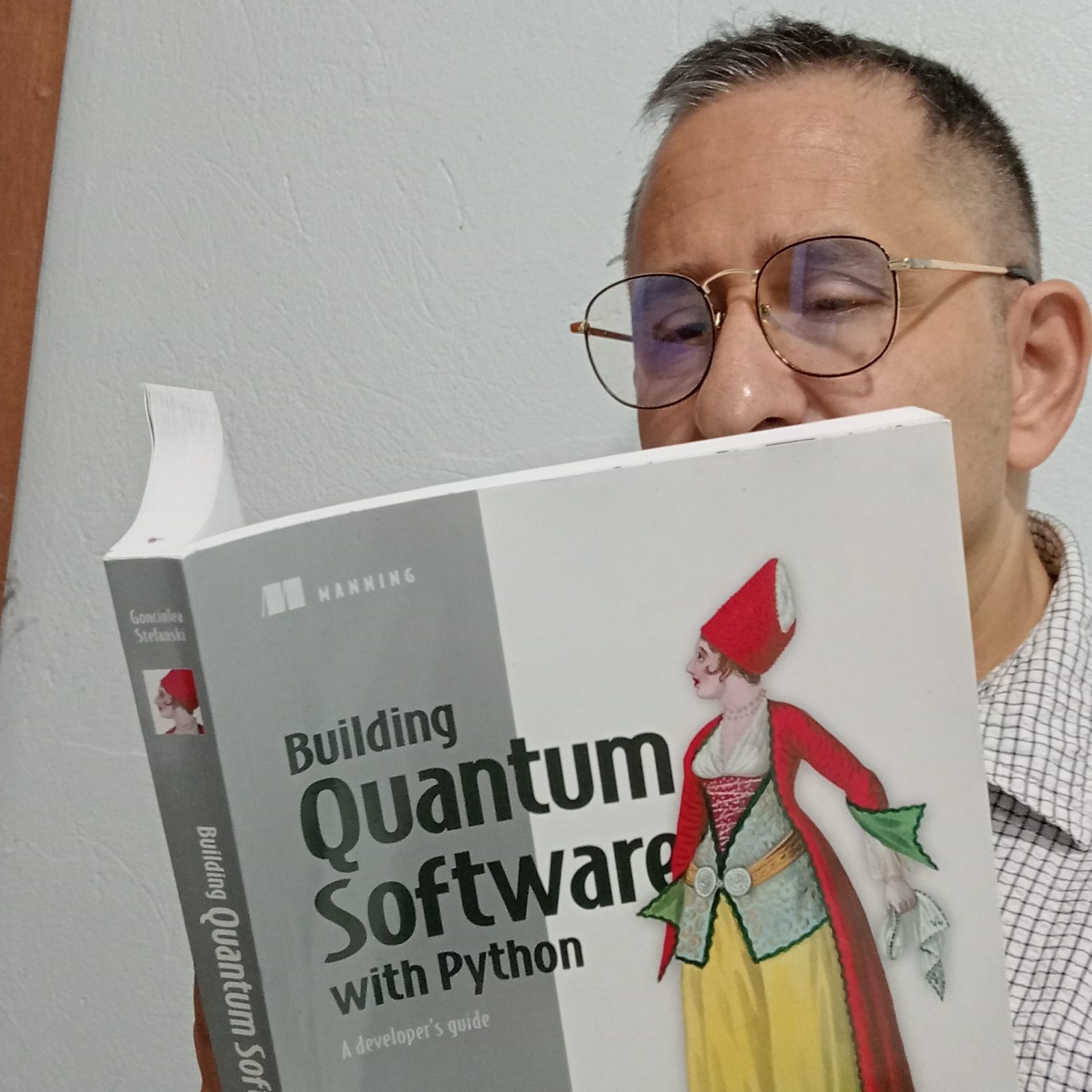
The first analogy I encountered in Dr. Constantin Gonciulea’s and Charlee Stefanski’s “Building Quantum Software in Python: A developer’s guide” is, of course, financial. Even though I’ve taught accounting before, and I know that when you debit one account you have to credit another (oversimplified), I’ve never thought to apply that to quantum.
Put Your Brand in Front of the Industry’s Decision-Makers
The Leading Source for Actionable Intelligence to the Quantum Computing Industry
Inside Quantum Technology provides unparalleled access to the professionals shaping the future of actionable intelligence related to quantum computing and the evolving industry. Our advertising and sponsorship programs enable your organization to elevate brand awareness, demonstrate industry leadership, and build meaningful connections with a highly engaged audience of engineers, executives, researchers, and technology innovators.
Increase Your Brand Exposure—and Drive Real Results
✓ 100,000+ monthly visitors
✓ 40,000 + email and newsletter subscribers
✓ Robust and engaged social media network
✓ Thousands of annual conference attendees
Whether you’re launching a new product, accelerating brand awareness, or staying top-of-mind with key decision-makers, our targeted advertising solutions are designed to deliver measurable impact and high-quality leads.
A Molecular Qubit that can be Accessed and Controlled Using Light
Following the announcement that NVision has unveiled the first manufacturable molecular qubit in a peer-reviewed Nature paper, Ilai Schwartz, CTO and Co-Founder at NVision, provided this exclusive comment:
“Before I dive in, to borrow a line from The Quantum Dragon: our molecular qubits might not be the qubits the quantum computing industry expected, but they could be the qubits it needs. To answer your question, our partnership with HyperLight is a critical step toward bringing our quantum computing architecture to market. Our Nature paper demonstrates the fundamental building block: a molecular qubit that can be accessed and controlled using light.
Now we need to integrate these molecules onto photonic chips. HyperLight brings the advanced photonic chip technology and manufacturing expertise to help us do exactly that. Our ambition is to build scalable, rack-sized quantum computers that can fit into existing data centers, without requiring massive, specialized infrastructure. This partnership brings us a significant step closer to making that vision a reality.”
A Way to Demonstrate and Calibrate Breaking RSA-2048 on Early Quantum Processors
Following the announcement from Alice & Bob that it lowered the quantum resources required to “break Internet encryption,” Dr. Dahmun Goudarzi, Senior Cryptanalyst at Alice & Bob and author of the paper, provided this exclusive comment:
“While this publication shows impressive numbers to benchmark Shor’s algorithm for RSA-2048, a hidden gem in the paper is the result for the application to a different problem, finite-field discrete logarithm (FFDLP).
This problem, less deployed and broken classically for the instance we are considering, offers the benefit of using the exact same operations and requirements as for RSA-2048, but at a much smaller scale. This gives us a realistic stepping stone: a way to demonstrate and calibrate the full method on early quantum processors, long before machines are large enough to tackle RSA-2048 itself.”
“2027 is the last year organizations can afford to start planning if they expect to meet the deadlines.”
Following the publication of NIST IR 8547 Transition to Post-Quantum Cryptography Standards, Chris Hickman, Chief Security Officer at Keyfactor, provided this exclusive comment:
“NIST’s report clarifies how organizations can put together a program that looks at cryptography as a whole and considers the risks associated with it. While it is intended to help government agencies meet the timelines established by Executive Order 14412, it is equally useful for other organizations as they prioritize how to approach a PQC migration. It helps government organizations and industry refine their plans against the established migration timelines and better understand what risk looks like as it relates to encrypted data. It also acknowledges hybrid cryptography as a potential way to facilitate a smoother transition in complex environments where moving solely to post-quantum cryptography may not yet be an option.
The report repeatedly calls out the complexity of a migration to post-quantum cryptography. The amount of effort required should not be underestimated. This is not a simple software upgrade or an overnight patching process. It is a long-term endeavor. In my view, 2027 is the last year organizations can afford to start planning if they expect to meet the deadlines. Waiting beyond that puts their ability to complete the migration on time at serious risk.”
You can’t hire quietly at scale.
Following the announcement by Coresignal that quantum computing job postings in 2026 already exceed all of 2025, Karolis Didziulis, Product Director at Coresignal, provided this exclusive comment:
“Job postings are one of the clearest early signals of where a company is really heading. Companies can stay vague about their quantum plans, but they can’t hire quietly at scale. Our data shows consultancies and IT service firms now post more quantum roles than hardware makers. Businesses are preparing for quantum well before most have said so publicly.”