
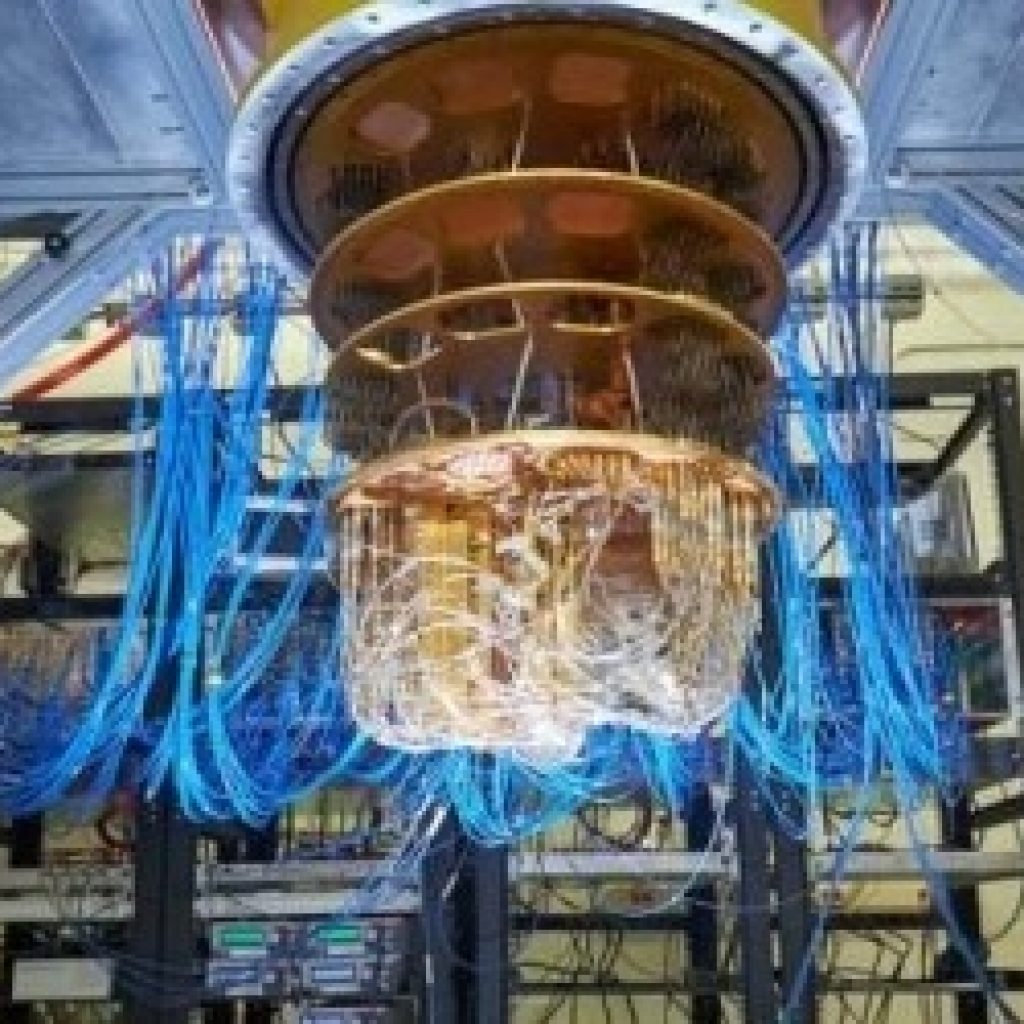
(WashingtonPost) Google, along with physicists at Stanford and Princeton universities, claims to have developed a “scalable approach” to time crystal creation using the company’s Sycamore quantum computer.
“Time crystals are like a rest stop on the road to building a quantum computer,” said Norman Yao, a molecular physicist at the University of California at Berkeley.
In a paper published last month on the research-sharing platform Arxiv.org, a team of more than 100 scientists describes setting up an array of 20 quantum particles, or qubits, to serve as a time crystal. During experiments, they applied algorithms that spun the qubits upward and downward, generating a controllable reaction that could be sustained “for infinitely long times,” according to the paper.
Quantum computing is weighed down by hard-to-control qubits, which are error prone and often die. Time crystals might introduce a better method for sustaining quantum computing, according to Yao, who published a blueprint for making time crystals in 2017.
“Time crystals are a weighted benchmark, showing that your system has the requisite level of control,” Yao said.

This corpus is a diverse collection of text data from various sources, including websites, articles, and documents, covering topics such as technology (particularly quantum computing and machine learning), data protection and privacy policies, professional development and training, and company information. This collection includes contexts from many websites, financial reports, investor information, and corporate governance, which can be drawn upon to provide information and answer questions.